Friday, September 22, 2017

The Martini

This next post is a bit of a departure from my normal posts but isn't entirely inconsistent. My book "Those Fantastic Classic Cocktails-Histories & Recipes" has just been released by Amazon as a Kindle book. If you view genealogy and family history as legitimate subjects of history, and who could dispute that, then it follows that this is also history. I hope you enjoy it.

MARTINI

Image result for public domain martini images


This is truly the most iconic of all cocktails, not just classic cocktails. The Martini has a rich and storied history. More has been written about Martini’s than any other cocktail. It has a lore all its own. 

Almost every tavern and restaurant today has a Martini menu with numerous Martini like concoctions. Personally, I do not believe they are truly Martinis. They are just cocktails served in a Martini glass. After all, how could you seriously believe a drink called “Jamaica Me Crazy” is actually a Martini? But I digress. 

As is the history of many of our classic cocktails, the origin of the Martini is clouded in mystery. One of the few facts that can be agreed on is that it started in the 1800’s. There are numerous different stories about the origin of the Martini. H. L. Mencken called the Martini "the only American invention as perfect as the sonnet"

One popular story is that it was invented in San Francisco at the Occidental Hotel by bartender Jerry Thomas. The story goes that a miner on his way to Martinez during the gold rush, asked the bartender to create him something special. Thomas created a concoction that came to be known as the Martinez which some claim to be the precursor to the Martini. However, the people of Martinez, CA, claim the Martini was first created right in Martinez by a bartender named Julio Richelieu in 1870. They claim a miner was tired of drinking whisky so Richelieu created a drink with gin, vermouth, orange bitters and an olive thus giving birth to the Martinez. Even this story isn’t universally agreed upon. Some claim that the miner really wanted Champaign after just making a big strike but the tavern didn’t have it. Therefore, the bartender concocted the Martinez instead. 


Another story has the cocktail being invented at the Hoffman House in New York in the 1880’s. The Hoffman House, once a very popular establishment, was torn down in 2015. They are credited with making Martinis dry. They took out the sweet vermouth and substituted dry vermouth. The classic Martini hasn’t changed much since then.  There are many other stories about the creation of the Martini but these are my favorites and generally most accepted possibilities. 

Luminaries, politicians, writers and athletes, a veritable list of who’s who, were Martini drinkers. The quotes that sprang up around the Martini will fill a book alone. In fact, Noel Coward once said “anyone can write books, but it takes an artist to make a dry Martini.”

Some of the notable Martini drinkers were Ernest Hemingway, President Franklin Roosevelt, Winston Churchill, Frank Sinatra, Humphrey Bogart, Steve Allen, Jackie Gleason, Johnny Carson, Dr. Seuss, Dean Martin, and the list goes on. In fact, President Roosevelt was an avid Martini drinker. He carried a Martini kit where ever he went. He is alleged to have served one to Joseph Stalin at the Tehran conference, and he liked it. 

I will leave you with a couple famous quotes about the Martini. George Burns once said “I never go jogging; it makes me spill my Martini.” Rodney Dangerfield once said "I drink too much. The last time I gave a urine sample it had an olive in it." Finally, Dorothy Parker said "I like to have a martini, two at the very most --After three I'm under the table, After four, I'm under my host." 
The classic Martini recipe contains gin. Vodka, which is quite popular in Martinis now, wasn’t very popular in the United States at the time. So the following recipes contain gin. 

Classic Dry Martini

 6 Parts Dry Gin (such as Beefeaters)
1 Part Dry Vermouth

Shake with ice and strain into a chilled Martini glass Garnish with an olive or lemon twist. 

Hoffman House Martini


4 oz gin
1/2 oz dry vermouth
4 dashes orange bitters

Method  Stir ingredients together with cracked ice in a mixing glass. Strain into a chilled cocktail glass. Garnish with an olive, and serve.


Tuesday, August 29, 2017

1951


There are many attractions to family history and telling our story. Sharing family stories, recipes, old photos, connecting with relatives and finding new family members. It is important to understand the world our family members lived in. That is a large part of their story and history. This is also an overlooked part of our family histories.


There is a series of books called “The Year Was –“. This series of books focuses on one year per book. I am not sure how many years they do it for but it is a great series of books. The books are published by Flickback Media, Inc., Chatsworth, CA. The web site is flickback.com and their telephone number is (800) 541-3533. I buy them at Poopsies in Galena, IL, a novelty sore I just love. I highly recommend the books if you can find them.


I was born in 1951 so I am going to focus on what the world was like in 1951, with the help of the book and wikipedia.com, the online encyclopedia. I was born on November 11, 1951. What was the world like in 1951.


Harry S. Truman was President of the United States and we were engaged in the Korean War. On January 4, 1951, North Korea and China captured Seoul for the second time only to lose it again on March 27. A court in West Germany found Ilse Koch, “The Witch of Buchenwald” and wife of the commandant of Buchenwald concentration camp is sentenced to life in prison. On February 6, a Pennsylvania Railroad passenger train derailed near Woodbridge Township, New Jersey killing 85 people and injuring over 500. The 22nd Amendment to the United States constitution term limiting the President was ratified on February 27.


The first NBA All Star game took place and the Julius and Ethyl Rosenberg’s trial begins resulting in their conviction for treason and are sentenced to death. General Douglas MacArthur is relieved of duty by President Truman. King Abdullah I of Jordan is assassinated by a Palestinian on July 20.  Winston Churchill is re-elected Prime Minister of Great Britain. And, on my birthday Juan Peron is re-elected President of Argentina. The Marshall Plan expired on December 31. That is a brief recap of the political state of the world in 1951.


The year in movies saw Humphrey Bogart win the Best Actor Oscar for “The African Queen” which co-starred Katherine Hepburn. Gene Kelly starred in “An American In Paris” which won the Best Picture Oscar.  Marlon Brando was outstanding in “A Streetcar Named Desire” for which Vivian Leigh won the Best Actress Oscar, Karl Malden won the Best Supporting Actor Oscar and Kim Hunter won the Best Supporting Actress Oscar. “Showboat” with Ava Gardner, Howard Keel and Kathryn Grayson was released in 1951. Top box office stars of 1951 were John Wayne, Bing Crosby, Doris Day, Bob Hope, Martin & Lewis, Abbott & Costello, Spencer Tracy and Gary Cooper.  


Television, that relatively new medium, had an impact on 1951. Top TV shows were “The Jack Benny Show”, “You Bet Your Life” with Groucho Marx, “Arthur Godfrey’s Talent Scouts” and “Your Show Of Shows” with Sid Caesar and Imogene Coca. Imogene Coca won the Emmy as best actress, Red Skelton won best comedian Emmy for “The Red Skelton Show” which also won for the best comedy show, and Sid Caesar won for best actor for “Your Show Of Shows” which also won for best variety show. “Studio One” took the Emmy for best drama. Milton Berle, Mr. Television, signed a 30 year contract with NBC.


On the radio, “Amos ‘n’ Andy”, “Fiber McGee & Molly” and “Sky King” were top programs. General Electric was a leading manufacturer of radios in 1951.


Dinah Shore was the favorite female singer. Hank Williams “Cold, Cold Heart” was number one on both the country and pop charts.


Top Broadway shows were “The King & I” with Yul Brynner, “Guys And Dolls” with Robert Alda and “The Rose Tattoo” by Tennessee Williams. Top books were “Catcher In The Rye” by J. D. Sallinger, “The Caine Mutiny” by Herman Wouk, and “From Here To Eternity” by James Jones.


In 1951, apples were a dime a pound, eggs 59 cents a dozen, milk 23 cents a quart, bread was 20 cents a loaf, and coffee was 79 cents a pound. A phone call was 10 cents and a paper back book was a quarter. A three bedroom apartment on Park Avenue in New York was $450/month. I wonder what it is today.


In sports, Joe DiMaggio announces his retirement, Bobby Thompson had the shot heard around the world when he homered against the Dodgers to go to the World Series. The Rams beat the Browns 24-17 to become NFL champions. Michigan beat California in the Rose Bowl 14-6. Dick Kazmaier from Princeton won the Heisman Trophy, The Rochester Rockets beat the New York Knicks 4-3 to win the NBA and George Mikan of the Lakers, then in Minneapolis, won the scoring title. Kentucky beat Kansas State 68-58 to win the NCAA National Championship for basketball and Bill Spivey from Kentucky was selected outstanding player.


In boxing, very big in 1951, Jersey Joe Walcott KO’d Ezzard Charles to become heavy weight champion. Jake LaMotta and Sugar Ray Robinson were middleweight champions. Ben Hogan, coming back from sever injuries suffered in an auto accident in 1949, won the US Open in golf. Dick Savitt won at Wimbledon, The Maple Leafs beat the Canadians for the Stanley Cup and Country Turf, a 15-1 shot, won the Kentucky Derby.  


That’s a brief review of the year that was 1951. This is the world I was born into. If you enjoyed this, stay tuned for more of these. I hope to do 1957 in the near future.


Wednesday, August 16, 2017

THE IMPORTANCE OF A FAMILY TREE

Recently, Suzie Kolber  a volunteer at the Obituarieshelp.org about promoting why creating a family tree is important. She volunteered to write an article about this topic. I believe it to be an excellent idea and am gratified that she did so. Below is her submission. 

Suzie's websites are:

obituarieshelp.org (This is where she volunteers and I recommend giving it a visit)

 http://obituarieshelp.org/free_printable_blank_family_tree.html (This is Suzie's online resource for DIY genealogy projects and free printable forms and trees) The page has been endorsed by several institutions like Brigham Young University,

Auburn University and various state and federal agencies and I think this would be helpful to anyone that is starting the task of researching their own family.What is even more impressive is that this site receives over 400,000 visitors monthly and helps adults and chilfren alike in starting/creating a tree.  Suzie should be commended for her dedication and efforts to this very worthwhile project.


3 Situations When a Family Tree is Important

Many people think of a family tree for use if you are researching your family history. While this is a beneficial use for it, there are many other ways you can use a family tree. Here are three other times when it can be an important part of your project or event.
 

1. It Can Help Kids in School
 
A family tree doesn’t have to be just about your family. You can use it when kids are studying history in school. It’s often difficult to keep family names together when studying an era. A family tree can help kids see the relationships of the people they are learning about. For example, a lot of people get mixed up about what relation Franklin D. Roosevelt and Theodore Roosevelt were to each other. A family tree on the Roosevelts would make it much easier to understand. Sometimes your kids can get extra credit in school for creating one as an outside project.


2. It Can Introduce an Adopted Child to the Family
 
Meeting a bunch or relatives for the first time can be overwhelming to a child who has recently been adopted. They may have a difficult time trying to keep names and relationships straight. Was Aunt Susie or Aunt Carrie the mom of Joe? Is Aunt Susie married to Uncle Bob or was it Aunt Ella?
When you create a family tree with everyone’s names organized and other basic information included, such as birthdays, it makes it easier for someone to keep track of their new family. Put their name as your child on the family tree, and it solidifies their status as part of your family. This is a great gift to give on adoption day if you frame it, but you can also give it to them ahead of time so they have a chance to learn about their family before meeting them all.
 

3. It Can Enhance Self-Confidence
 
There’s an old saying that goes, “you can’t know where you’re going until you know where you’ve been.” This is true for people in many cases. They often struggle with decisions about going to college, getting a job and making other choices. Sometimes it can help to research the past in connection with family.
A child who dislikes their hair color might have a stronger appreciation for it if they see that it goes back four or five generations. It can also be helpful to learn about the struggles of the past in their family. Maybe someone had to deal with a problem of stuttering or dyslexia in the past, which will help your child deal with their own struggles. On the other hand, they will feel pride if they discover an ancestor who inspired change or invented a helpful gadget.
A family tree can be a great way to help a child improve in school, build family ties or develop self-confidence. With so many templates to choose from, you’ll find the perfect option for any need.

Suzie Kolber created http://obituarieshelp.org/free_printable_blank_family_tree.html to be the complete online resource for “do it yourself” genealogy projects.  The site offers the largest offering of free_printable_blank_family_tree family tree charts online. The site is a not for profit website dedicated to offering free resources for those that are trying to trace their family history.

T

Friday, April 28, 2017

Our Easter 2017

I'm a little slow in posting this. Easter is a special time, much like Christmas, for our family to get together and celebrate. This year was no different. My sister posted some old pictures and remembrances from Easters past and I am very thankful for her post and sharing those pictures and stories. This blog is important to me if for no other reasons to capture those stories and photos while we can, for future generations. They will tell our stories. I wish something like this existed a hundred years ago and then we would know what life was like for our ancestors, what they thought, how the celebrated special occasions, etc. It is to late for that and we can't ask them now. But we can leave a legacy of us for our future generations. With that said, I hope you enjoy the photos from my families Easter.


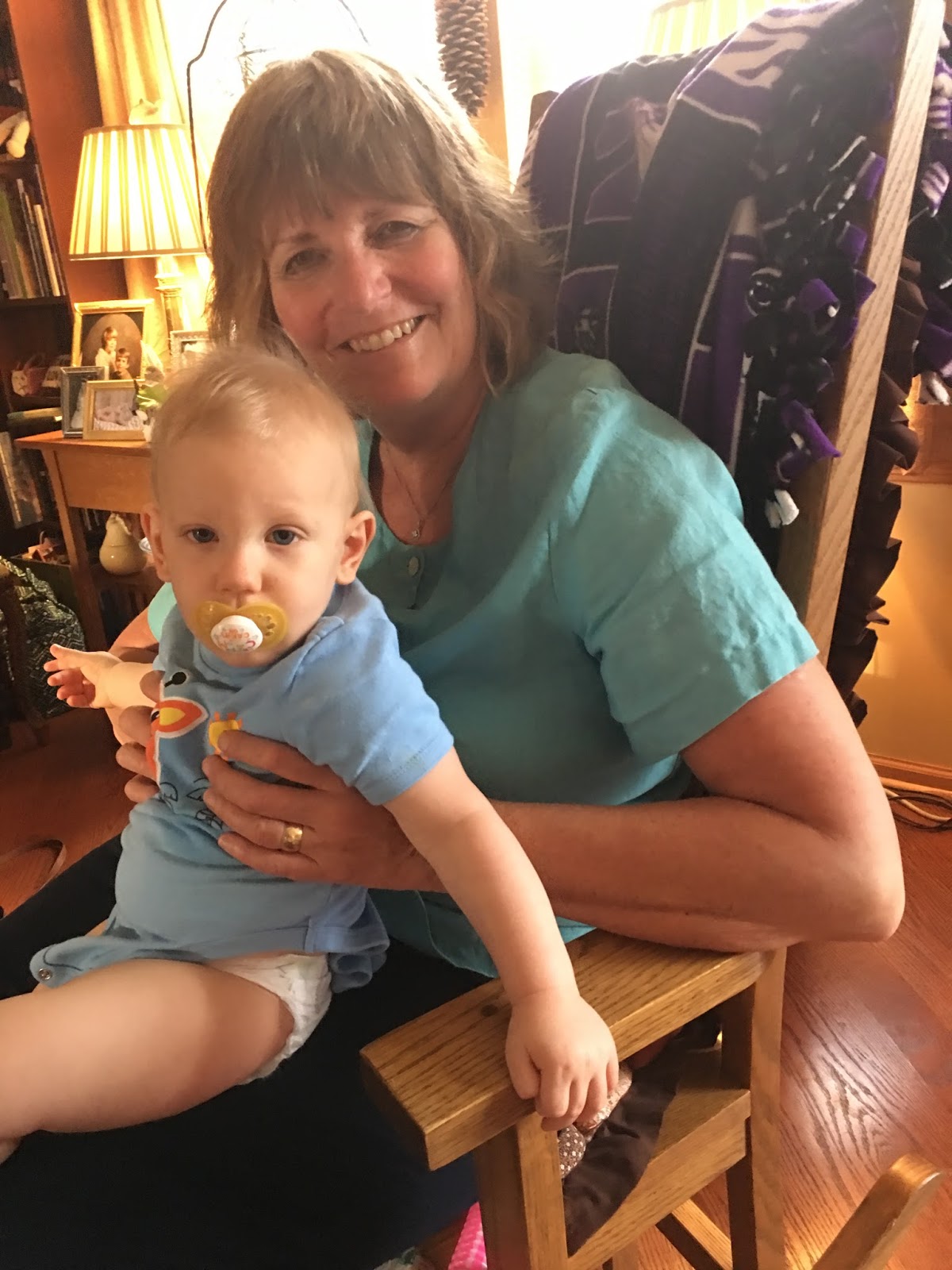
My Grandson, Samuel Elliot Youmans age 11 months


Sammy is a happy baby.


Our Easter table.

My Granddaughter Phoebe Rebecca Sharp.


My son Samuel Nathan Youmans and his wife Megan McNeely. These are Sammy's parents.

At the dinner table. Left to right. Samuel Youmans (me), Krysta Joan Youmans, Phoebe, Megan, Sammy, Sam , and my wife Rebecca Linn (Uhlhorn) Youmans - Becky.  


Another photo at the dinner table this one includes my wife's sister Christine Uhlhorn at the right.

Becky with baby Sammy and Krysta.

My daughter Krysta.

Becky and baby Sammy.

Our cat- Punkin. He enjoyed Easter also.

This picture has nothing to do with Easter. We were in Milwaukee with friends for a weekend and went to this place called Sobelman's for lunch. It is just a hole in the wall place that specializes in burgers and Bloody Mary's. The line was out the door and it was wall to wall people inside. It took us over a half hour to get a drink. It was worth the wait. This is from their menu. It is their Bloody Beast Bloody Mary. It is $50 and comes with an entire chicken on top of it. We did not order this but I had to capture a photo of it.


Christine who brought dessert. What an amazing cake.

Another photo from Milwaukee with our friends. Posing with a statue of the Patron Saint of Beer. Appropriate.

I hope you enjoy the post and thanks for looking.


Saturday, April 15, 2017

Easter Holiday

Tomorrow will be Easter and along with it comes a fold of fond memories!!  Our Mom always made sure we had brand new outfits right down to the little white gloves and the patten leather shoes!!  I never remember my parents hiding our baskets except one year when we spent it in Pa. at my Mom's brother Ed Carlisle, we didn't get outfits that year either!!  For me Easter was the beginning of nice weather and yes summer break!! These days Easter is still filled with loved ones lots of good food, and we have a big Easter egg hunt between me and the neighbor and all our Grandkids,  Tomorrow as I enjoy the ones I love I will also take a minute to thank my Lord for his saving Grace.
 SAlly, Sammy, and Sandi

 Sandi's 2 girls Heather and Dorothy

 Cousin's Bobby & Debbie Carlise Sally, Sandi, Sammy

Saturday, March 18, 2017

SAMUEL HOLGAR YOUMANS

Samuel Holgar Youmans (Sam), March 18, 1927-August 17, 1993. Sam is my father and would have been 90 today. Unfortunately, and sadly, he died much to young in 1993. I once heard that anyone can be a father, but it takes a special person to be a Dad. Sam was a special person.

Sam was the fourth child of Samuel Harvey Youmans and Hazel Victoria (Vautier) Youmans. He was born in Hopewell, VA and had three sisters and two brothers. The family moved to Ohio during the depression in search of work and finally settled in Sebring, OH where I grew up. Sam married June Evelyn (Carlisle) Youmans on April 10, 1951. They settled in Sebring and had three children. They were married for 42 years, until my Dad's death.

Sam left High School to enlist in the Navy during World War II. After his discharge from the Navy after the War, he went back to High School where he graduated in 1947. Dad had been accepted to Tulane In University and was going to go to on the GI Bill. For whatever reason, he never went and stayed in Sebring. Dad, like most people in Sebring, went to work in the pottery. He worked at the Royal China Co. until it went out of business in the 1980's. He was a kiln placer which was one of the better jobs in the pottery. He was active in the union and was a long time president of Local 59 which was part of the potters union which was part of the AFL-CIO. He also organized the Summer Potter's Picnic and the annual Christmas party. Dad was well liked in the community. He was an intelligent man and an easy going person.

Dad always enjoyed music and singing. He was in the Blue Jacket Choir while in the Navy. He had many favorite performers but as I recall from the records he had when I was young, Johnny Mathis was a favorite. He also used to sing around the house and especially liked "Roses Are Red" by Bobby Vinton. There was another part of a song he used to sing but I don't know where he got it. It went "Waterloo, drip, drip, drip."

Dad also enjoyed sports. He especially liked football and the Browns. Dad played football in High School. I remember the first Browns game he took me to. It was against the Cardinals in 1960. Jimmy Brown was still playing which was a treat. The first baseball game I ever saw was the Indians against the Red Sox with Ted Williams in 1959. This was right before Williams retired. The Red Sox won and I seem to recall Williams hit two home runs.

One of Dad's best friends was Theopane Stevie Steve. He owned a tavern in town called the Crystal. Dad would help Stevie by bartending and cleaning up on Sundays. Stevie died in a car accident I believe in 1962 and I recall my Dad being pretty dad about it. In addition to being a potter, my Dad would occasionally bartend. In fact, after the Royal shut down, he would often bartend at the Log Cabin which was owned by another life long friend. Dad also worked as a butcher part time. No question, my Dad was a very hard working man.

I have one favorite thing that I would like to share. Dad would often take me and my sisters fishing at Berlin Lake. We had our own special spot. Anyone who fishes, know that the purpose of a fishing trip is not to catch fish. That is what made this spot so special. We were never bothered by fish trying to be caught. Dad would fill a cooler with beer and pop, we would stop at a bait shop and get some worms, and take our bamboo poles out to the lake and have a ball. Funny what we remember.

I miss my parents very much. At least I had my mother until she was 85. I lost my Dad way to soon. I just wanted to remember him on what would have been his 90th birthday.

1947 Senior Class Picture


Mom and Dad with me

Mom and Dad's Wedding Day-Pictured are Grandma Hazel, my Dad, my Mom, and Grandma Carlisle

Dad at Christmas 1970's.

Dad and his brothers, left to right, Dad, Billy and Harry


Dad in his Navy uniform

Dad, Mom and my daughter Krysta Christmas 1985in Cincinnati


Dad, me and my cousin heather at the Fourth of July parade 1987 in Glen Ellyn, IL


Saturday, March 11, 2017

SIR ROBERT YEAMANS-ROYALIST


Sir Robert Yeamans was born in 1597 and died in 1643. He is a historic character in English history both in his town of Bristol and as a result of the English civil war.


Robert married his cousin Anne Yeamans on March 16, 1627 in Bristol, England. They had eight children together the last of which was born after his death. After his death, Ann married Thomas Speed to whom she had one child. Anne was born in 1602 and I do not know when she died. She was the daughter of William Yeamans and Ann Tomlinson.


Robert Yeamans was a well known merchant and counselor in Bristol. He also served as Sheriff of Bristol from 1641-1642. He was also a strong supporter of King Charles I. The Yeamans were very prominent in Bristol and later in the Barbados and Carolinas in America. In 1643, Robert was involved in a plot with other Royalists to aid in the capture of Bristol. The plot was discovered by the Parliamentarian Governor Nathaniel Fiennes. Yeamans was tried as a traitor by court martial, found guilty, and executed outside his home in Bristol.


Yeamans was a Royalist in his sympathies, and he obtained a commission from King Charles I  to raise troops from Bristol, but in December, before he could accomplish the task, the city was occupied by a parliamentary force under the command of Colonel Essex. In February 1643 Nathaniel Fiennes became the parliamentary military governor of the city.


Early in 1643 Yeamans conceived a plan for turning the city over to a Royalist army under the command of Prince Rupert. He communicated with Charles I, who was then at Oxford, and the king sent him a commission to enlist men in his service. Prince Rupert was to bring four thousand horse soldiers and two thousand foot soldiers to Durdham Down, and the Royalists in Bristol, who were estimated at two thousand, were to seize the Frome-gate and admit Rupert's forces. The plot was to take effect on the night of 7 March 1643.

Fiennes heard of the plot, and on 7 March, before they could execute the plan, Yeamans and his principal confederates were arrested in his house on Wine Street. A Brief Relation of the Plot was published by parliament on 13 March, various witnesses were examined in March and April, and on 8 May Yeamans was condemned to death by a court-martial as a traitor.

Charles made great efforts to save him, and Lord Forth threatened to execute a similar number of parliamentary prisoners in his hands. The threat proved useless, as Fiennes also held other notable Royalist prisoners recently captured by Sir William Waller on his raid into Herefordshire, so to forestall a blood bath King Charles ordered that no retaliatory executions should take place.

Yeamans was hanged, drawn and quartered opposite his house along with his co-conspirator and friend George Bouchier.  Yeamans remains were buried in Christ Church, Bristol. When Fiennes was himself on his trial his execution of Yeamans was one of the charges brought against him.


The Battle of Bristol makes for some fascinating reading as does the entire history of the English civil war. Sir Robert can be added to the many colorful characters that appear to make up our family.


Sir Robert Yeamans

Nathaniel Fiennes